


.webp)

.png)
The Vimy Memorial and the 1936 Vimy Pilgrimage: 90 Years On
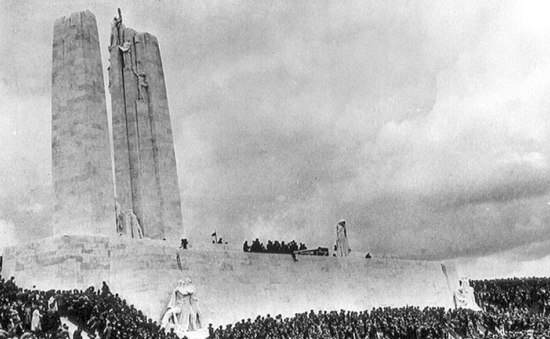
July 2026 marks the 90th anniversary of the 1936 Vimy Pilgrimage, when more than 6,200 Canadians crossed the Atlantic and walked the battlefields of France and Belgium on a remarkable journey of remembrance. Their primary destination was Vimy Ridge, where they witnessed the unveiling and dedication of Canada's most iconic overseas war memorial. The pilgrimage remains one of the largest peacetime movements of Canadians to Europe and the largest international reunion of Canadian veterans.
The Military Museums (TMM) in Calgary preserves several impressive artifacts associated with the 1936 Pilgrimage and other Canadian First World War veterans’ reunions. These objects serve as a tangible reminder of the efforts made by Canadian veterans to commemorate their service and to strengthen bonds with those who shared similar experiences.
It is as LCol F.L. Cartwright of the Lord Strathcona’s Horse wrote in 1936, “[I] expect to go to the unveiling at Vimy on the 26th and hope to meet some friends there.”1

A Monument Dedicated to the Fallen of Canada’s Costliest War
When people think of Vimy Ridge, they often picture the towering memorial in France. Among the world’s most exceptional war memorials, the Canadian National Vimy Memorial stands at the summit of Vimy’s First World War battlefield. Vimy was the site of Canada’s costliest ever battle, with more than 10,500 casualties over four decisive days of fighting in April 1917.
Although erected on Vimy Ridge, the monument stands for all Canadians who died in the First World War, and especially those who fell in France and have no known grave. The names of 11,2852 missing Canadians are etched into the monument’s striking twin limestone pylons which stretch 100 feet into the sky. To stand in the shadow of the monument and read the names of young Canadians lost over 100 years ago is a powerful reminder of the human cost of war.
.jpeg)
The Vimy Pilgrimage
Designed by Canadian artist Walter Allward, the Vimy Memorial was dedicated and unveiled to great fanfare on 26 July 1936. In the years leading-up to the event, the Canadian Legion organized and sponsored a large contingent of Canadians to travel to Europe for the ceremony. The Legion advertised that the all-inclusive cost for the entire journey would not exceed $160 per person (equal to $3,750 in 2026)3.

More than 6,200 Canadian “veterans and their families” were ultimately selected to attend the overseas battlefield tour. While many veterans were accompanied by family members on tour, others represented veteran relatives who could not travel or who had fallen during the war. The image of First World War veterans standing shoulder to shoulder with the families of fallen comrades on the former battlefields is deeply moving and unrepeatable.
The group of Canadians departed Montreal via five ships on July 16-17 for Antwerp and Le Havre. For those travelling from Western Canada, the journey had begun days earlier on a hot summer train ride towards Quebec. Upon their arrival in Europe, the travellers were billeted in Arras or Lille and, at every location, they were warmly welcomed as “pilgrims.”4 Indeed, this tour of the 6,200 Canadians was known as the “Pilgrimage to the Battlefields”5 or more commonly, the “Vimy Pilgrimage.” According to a contemporary reel produced by the Legion, the objective was “…[to] go as an army of Peace, as bearers of a message of goodwill bent on a sacred mission: To attend on the Heights of Vimy the stirring ceremony in honour of our fallen Comrades.”6
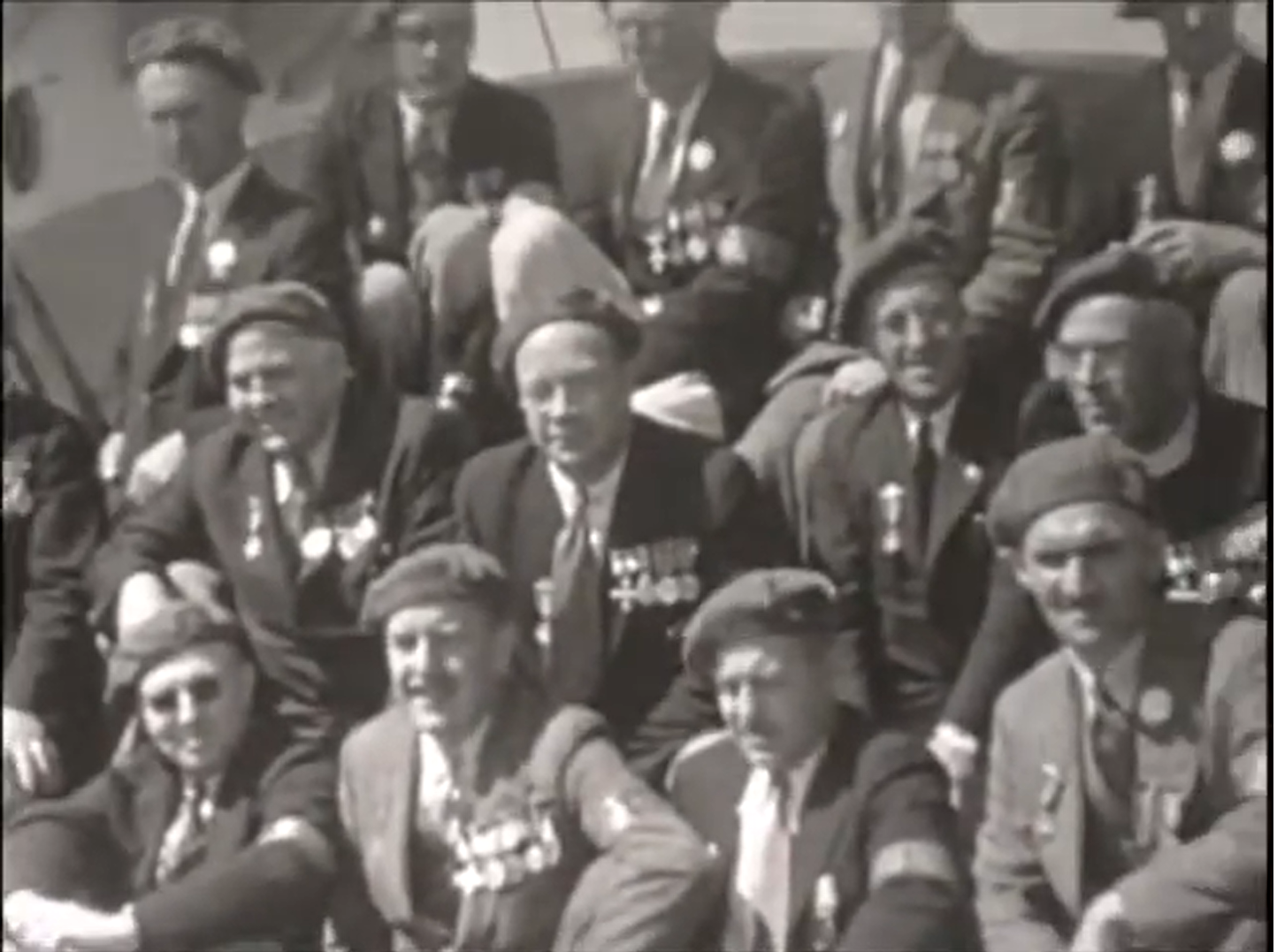
On the road to Vimy, and afterwards, the pilgrims visited other significant war sites, cemeteries, and memorials such as Thiepval, Hill 62, Passchendaele, Armentières, and Ypres (including the Menin Gate). Many of the structures and landscapes they visited, including Ypres’ iconic medieval cloth hall, were still being restored because of their wartime devastation.
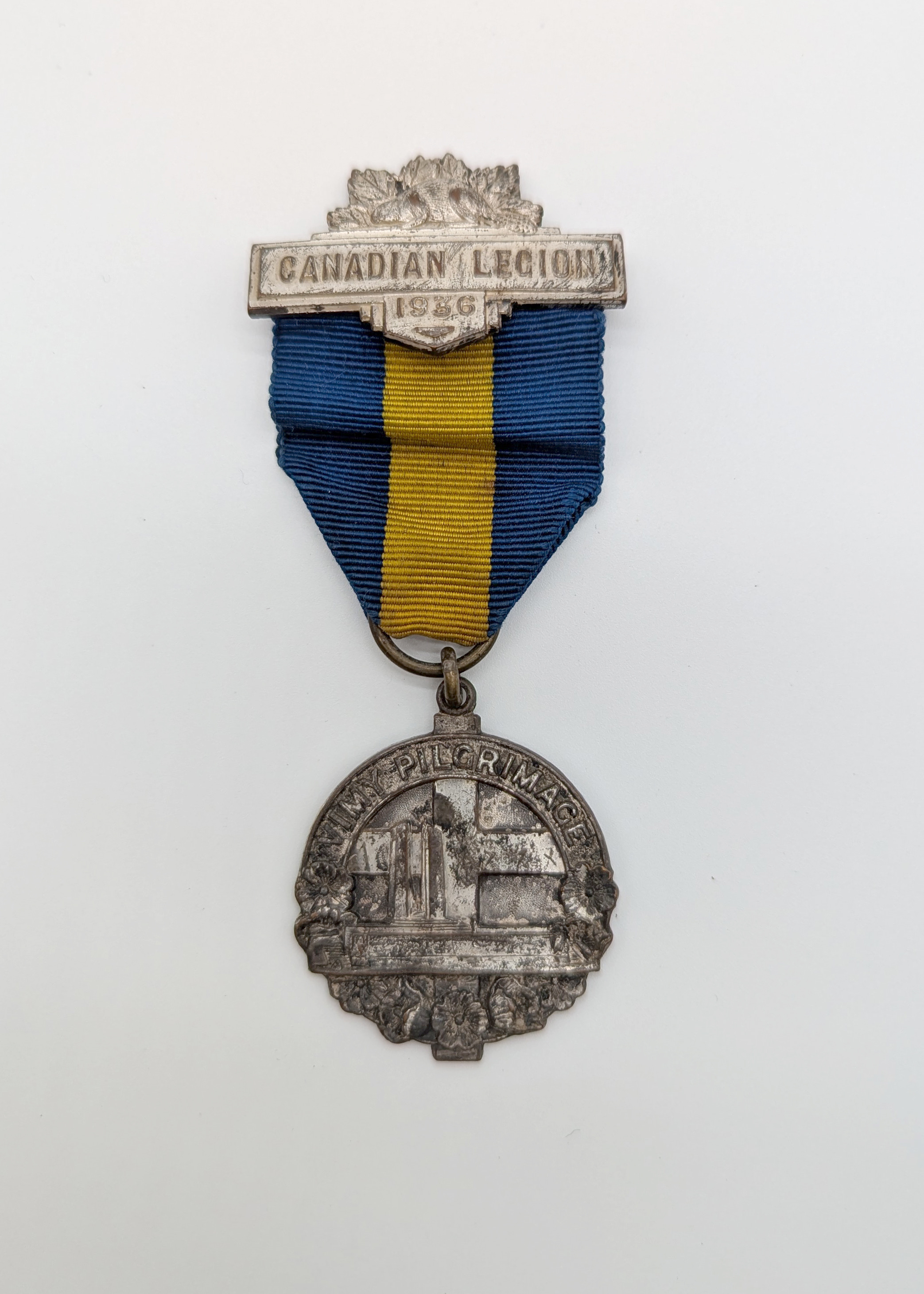
Throughout the Pilgrimage, from the ships to the cities and fields, many Canadian veterans proudly wore their original medal sets opposite to their “Vimy Pilgrimage Medal” issued by the Legion to every pilgrim [pictured]. Victoria Crosses, Military Crosses, Military Medals, Meritorious Service Medals, and others were seen gleaming in the same locations as the actions for which they had been awarded.
Upon their arrival at Vimy via a caravan of buses, the pilgrims explored the battlefield, walked through the restored trenches, and climbed the parapet walls. The experience of walking the battlefield through the eyes of the veterans and towards the memorial for the ceremony was captured by Gunner Herb Morden “…no photographs or word pictures, no matter how cleverly executed, can begin to describe [it]...”7
The Material History
Nine full decades later, the story of the 1936 Pilgrimage and of Canadian First World War veterans continues through artifacts preserved in museum collections across Canada. TMM maintains several of these objects which provide a tangible connection to the people and the events.
Among the museum’s collection is a light blue beret matched to the colour of the 3rd Canadian Division, with embroidered patches linked to the 2nd Canadian Mounted Rifles (2 CMR). Berets like this example [pictured], were commonly worn by veterans of the Canadian Expeditionary Force (CEF) at reunions organized across the country.

CEF reunions were especially well attended in the 1930s and the styles of berets worn by veterans at these events varied by time and place.8 Our featured reunion beret was worn by Corporal William Henry Carr, who, at age 20, was severely wounded by a grenade explosion at the Battle of Courcelette on 29 September 1916.9
.png)
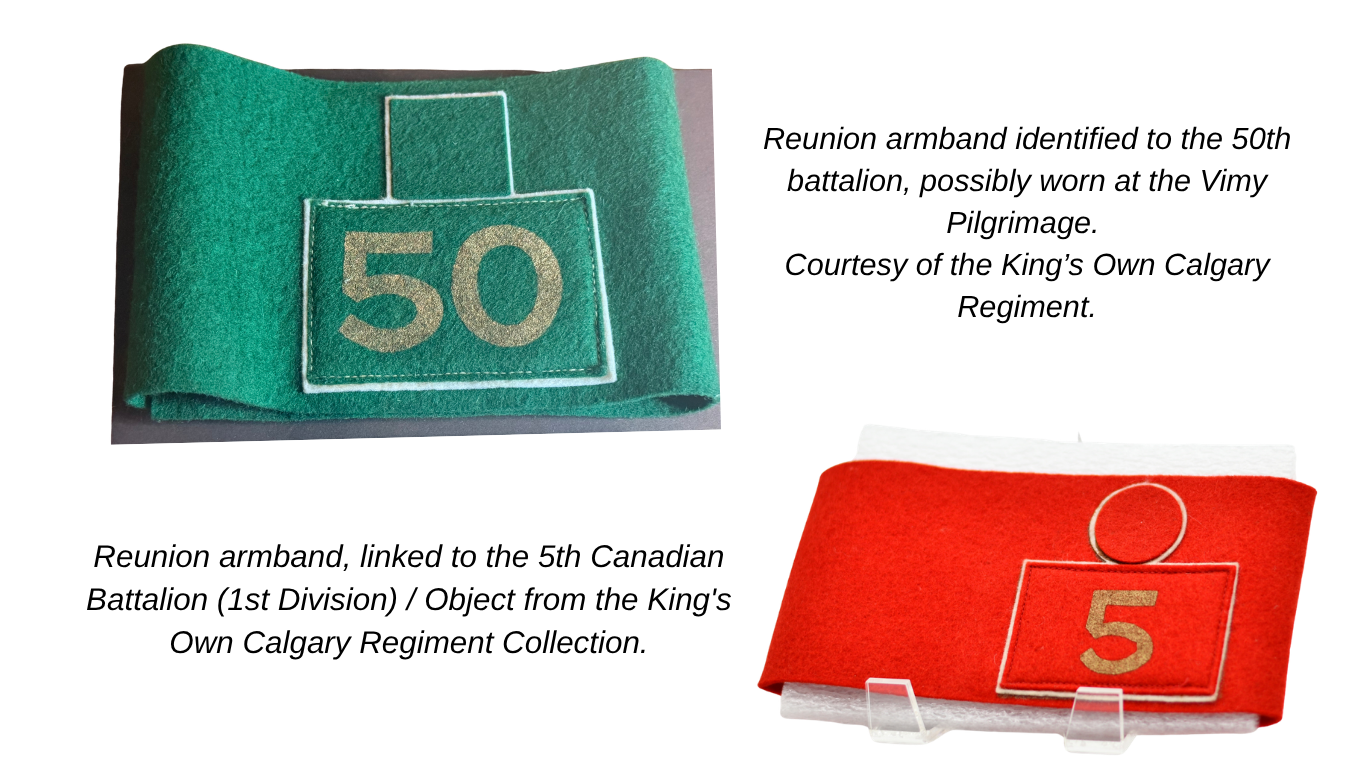
Like the berets, custom armbands (or brassards) were worn by Canadians during the Pilgrimage and at other postwar reunions and remembrance events. These armbands too were often designed to correspond with the colour of the wearer’s original Canadian Corps’ divisional patch (red, dark blue, light blue, or green). Such examples also included the respective battalion patches and a hand painted gold battalion number [pictured]. The use of colour to distinguish veterans and to link them to their former divisions and battalions was an important showing of solidarity and sense of belonging.
Standing Together on Vimy Ridge
An estimated 50,000 to 100,000 people attended the ceremony at Vimy on 26 July 1936. Within the large crowd, the Canadian contingent was given a place of honour in the amphitheatre directly before the monument.10 The event was widely regarded as a success, and Canada received a measure of international recognition for its substantial contributions and sacrifices during the Great War of 1914–1918.
The centennial of the battle on 9 April 2017 welcomed the largest audience to the memorial since its July 1936 unveiling with an estimated 25,000 to 30,000 people. This author attended that centennial ceremony, which included several poignant homages to the 1936 event.
.avif)
Welcoming approximately 200,000 people to the site per year, the Vimy Memorial remains a major international attraction and Canada’s central place of remembrance overseas. Over the last 90 years, Canadians have continued to make their independent “pilgrimages” to Vimy. The memorial’s original purpose endures, as does the implied responsibility for its care expressed in the inscription on the monument’s limestone, “This monument is raised by the people of Canada.”
1Letter, LCol F.L. Cartwright to Major F.C. Powell, published in The Strathconian: The Journal of the Lord Stratchona’s Horse (October 1936).
211,285 was the total number of Canadian First World War dead in France with no known grave as of 1936. In the subsequent 90 years, the remains of at least 31 Canadian war dead have been discovered and identified. See: Index of identified casualties - Canada.ca
The Menin Gate in Ypres contains the names of 6,940 Canadians who died in Belgium during the war, but have no known grave.
3Official Pilgrimage to Vimy and the Battlefields (pamphlet), 1934. City of Toronto Archives Series 1099, Item 146.
4Herb Morden, The Vimy pilgrimage, July, 1936: experiences, impressions and some random jottings, (North Vancouver: publisher unknown, 1936), 21-22.
5Canadian Pacific, July 1936 Pilgrimage to the Battlefields: List of Passengers (pamphlet), c. 1936. University of British Columbia. Rare Books and Special Collections. CC-TX-234-5-9.
6The Canadian Legion: Pilgrimage to Vimy, produced and photographed by Wilfred W. Prissick (Canadian Legion), c. 1936. Accessed from the Vimy Foundation.
7Morden, The Vimy Pilgrimage, 1936, prologue.
8Several sources contend that at the Vimy Pilgrimage, veterans were issued khaki berets and non-veterans were issued dark blue berets. However, dark blue berets were also worn by CEF veterans of the 2nd Division at other reunions. Selected dark blue berets, issued for the 1936 Pilgrimage, were perhaps later modified to reflect the service of 2nd Division veterans. For example, see the following with a 21st Battalion cap badge pinned: 21st Battalion blue beret. It is also quite possible that some veterans wore to Vimy their berets and armbands acquired from previous reunions.
9LAC, RG 150, Accession 1992-93/166, Box 1516 – 30. Carr survived the war and moved to Calgary where he passed in 1986 at age 99. Courcelette was the first time tanks were used in combat.
10Eric Brown and Tim Cook, "The 1936 Vimy Pilgrimage." Canadian Military History 20, 2 (2011), 46.
11Joffrey Levalleux, “The Vimy Memorial and its National Commemorative Park,” in Arras Tourisme. Accessed July 2026: Vimy, un morceau de Canada en Artois- Arras Pays d'Artois Tourisme