.webp)

.png)
Lord Strathcona's Horse (Royal Canadians)
Lord Strathcona’s Horse (Royal Canadians)
About
The Lord Strathcona’s Horse (Royal Canadians) Museum and Archives is dedicated to preserving the history of Canada’s only serving full-time tank Regiment and its journey from horse cavalry to modern main battle tanks.
Highlights
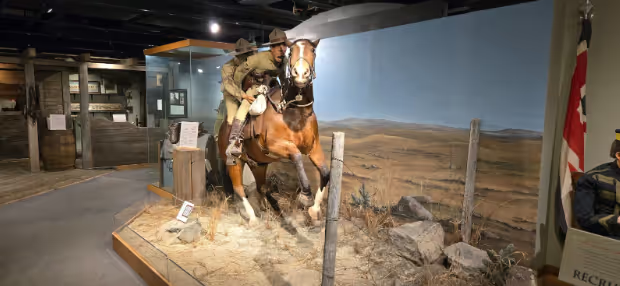
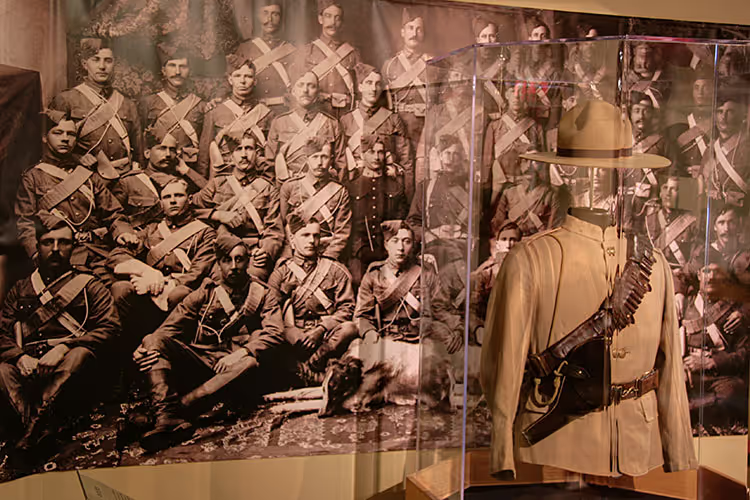
- Learn the story of the raising of the Regiment from western frontiersmen and cowboys.
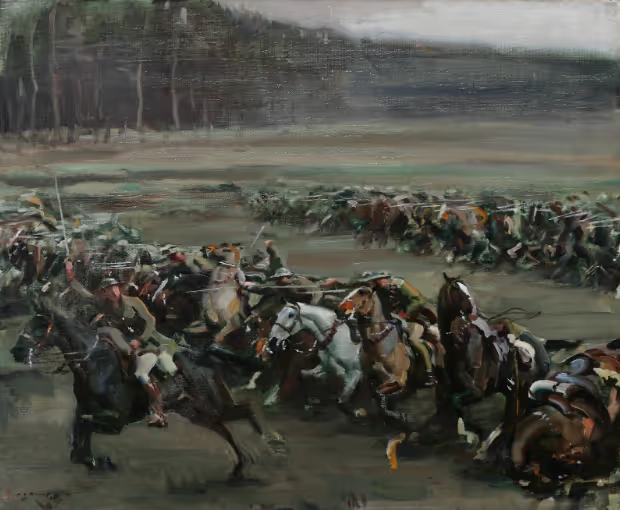
- Witness the Regiment’s decisive role in one of the last great Cavalry charges in history.
- Understand the history of the transition from horse cavalry to armoured tanks.
- Discover how Strathconas throughout history used mobility, flexibility, and perseverance to succeed on battlefields like South Africa, to France, and Afghanistan.
- Learn more about the Strathcona’s Regimental life and how it keeps its history alive with its Ceremonial Mounted Troop.
History
Shocked by British inflexibility at fighting irregular Boer Militias in South Africa, Donald Alexander Smith, Lord Stathcona, would raise a cavalry regiment in 1900 at private expense. This regiment would draw from Western Canada’s cowboys, frontiersmen, and mounties who could ride on horseback and live off the land. The Strathcona’s Horse would bring much needed mobility and flexibility to counter the Boers and their guerrilla campaign.
The First World War would see limited use of Cavalry in a war defined by stagnation and attrition. Held in reserve for most of the war, Strathconas would use their mobility to quickly reinforce areas in the line in need of desperate support. Lord Strathcona’s Horse would persevere through an evolving war and have its finest hour with the charge at the Battle Of Moreuil Wood - at immense cost.
At the outbreak of the Second World War, the Lord Strathcona's, still equipped with horses, would be rerolled as an armoured tank regiment. In 1943, after years training up on tanks, the Regiment would finally be deployed to the Italian campaign. Lord Stratcona’s Horse would fight with distinction leading the advance across the Melfa river during the breaking of the Hitler Line. Hard fighting would continue, as Strathcona’s fought through Italy before being re-deployed to Northwest Europe for the liberation of the Netherlands.
The end of the Second World War would see Strathcona's continue to use their flexibility and adaptability to take on new missions - from deterring Soviet aggression in West Germany, to numerous peacekeeping missions in the Sinai, Cyprus, and Former Yugoslavia. After the September 11 attacks, Lord Strathcona’s Horse (Royal Canadians) would go on to provide heavy armour capabilities to Canada’s mission in Afghanistan.