


.webp)

.png)
The King's Own Calgary Regiment (RCAC)
The First World War
The 50th Battalion CEF was mobilized in Calgary in November 1914, training in Calgary and Sarcee Camp. In June 1915, the first draft of five officers and 200 men left for England where many became reinforcements for the 10th Battalion in France where they fought at Ypres and Festubert in 1915. This accounts for the inclusion of those names in the 50th Battalion's Battle Honours.
The 50th again recruited to full strength and sailed from Halifax on 27 October 1915. On arrival in England it became part of 10 Brigade, 4th Canadian Division, CEF and arrived in France in August 1916. They took part in the battle of the Somme in October 1916, the attack on Vimy Ridge in April 1917 and the major battle at Passchendaele.
In 1918 after the German breakthrough, the Battalion held its positions on the Arras front, and in August the Battalion participated in the battle of Amiens and the subsequent breaking of the Drocourt-Queant Line. In September 1918, with another unit, the Battalion cleared the Bourlon Wood and in October 1918 it participated in the capture of Valenciennes.
Almost 5000 men served in the Battalion, and 900 were killed during the War. Among the many decorations was the Victoria Cross (VC) won by Pte J.G. Pattison. In present day Calgary there is a bridge spanning the Elbow River and a mountain in Jasper National Park named after this soldier.
The Second World War
The 14th Army Tank Regiment (The Calgary Regiment) was mobilized in February 1941. They left Calgary in March 1941 for Camp Borden to join the 1 Canadian Armoured Brigade, and arrived in Greenock, Scotland in July. They began training with Churchill tanks that September and in May 1942, the Regiment moved to the Isle of Wight with the 2nd Canadian Division to practice assault landings.
On 19 August 1942, the Regiment took part in Operation Jubilee, the Dieppe Raid. The Calgary Tanks went into history as the first tank regiment of the Canadian Army to engage in combat with the enemy. It was also the first occasion the “Churchill Tank” saw action.
The cost to the Regiment that fateful morning was high. Two officers and eleven men were killed, thirty-three men and officers wounded and taken prisoner along with 143 other men. Only five made it back to England out of the original contingent of 181 men who went ashore. Many of the POW's spent the rest of the war in captivity.
The Italian Campaign
The unit returned to Seaford where they were reinforced and reorganized. In May 1943 the regiment was issued Sherman tanks and the following month they left for the Mediterranean to take part in the Invasion of Sicily with the 1st Canadian Division. In September 1943 they landed in Italy and began advancing up the Adriatic Coast. They crossed the Sangro River in November 1943 and captured Lanciano and in December they fought in the Battle of the Moro River.
The following spring they engaged in the Battle of the Gari River and the break through of the Gustav Lines leading to the fall of Rome on 5 June 1944. From August to December 1944 they engaged in the assault crossing of the Arno River and then advanced to the Gothic Line.
Liberation of Holland
In March 1945, the Regiment was moved to Holland where they took part in the Battle of the Reichwald Forest and supported the crossing of the Ijsel River. They were on patrol when hostilities ended on VE Day, 8 May 1945.
Post World War 2
The Calgary Regiment's Second World War record was outstanding. To recognize the contribution the regiment made, King George VI granted the prefix “King's Own” to the regiment's name. Therefore, the regiment was re-designated the '14th Armoured Regiment (King's Own Calgary Regiment)' on 22 July 1946; 'The King's Own Calgary Regiment (14th Armoured Regiment)' on 4 February 1949; and lastly, 'The King's Own Calgary Regiment (RCAC)' on 19 May 1958.
Members of the Regiment have continued The King's Own Calgary Regiment's proud military traditions by volunteering for United Nations and NATO missions. In recent years the Regiment has served on Peacekeeping duties in Bosnia, Croatia, Cyprus, Congo, Golan Heights, and Darfur to name a few.
Canada's participation in the War in Afghanistan saw many soldiers from the regiment deploy in a variety of roles throughout the conflict. On 24 September 2007, The King's Own suffered its first combat fatality since the Second World War, when Cpl Nathan Hornburg was killed in action while serving in Kandahar province. Cpl Hornburg was posthumously mentioned in dispatches for his exemplary performance in combat and on Sep 24, 2025 two bridges on a major ring road in northwest Calgary were named in Cpl. Nathan Hornburg's honour. Signs honouring Cpl Hornburg are placed near the West Bow Bridges on Calgary's Stoney Trail.
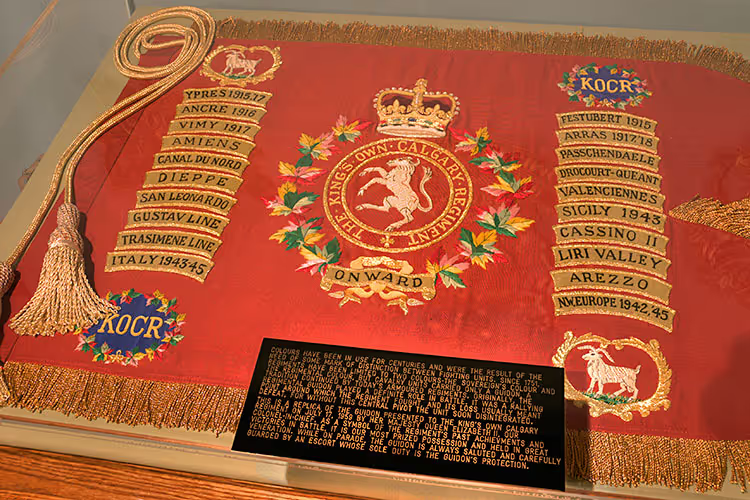
As a result of The King’s Own contribution to the War in Afghanistan, the regiment was awarded the Afghanistan battle honour in 2014, which the unit proudly displays on their guidon.
Today, The King's Own Calgary Regiment (RCAC) is a Royal Canadian Armoured Corps cavalry regiment of the Canadian Armed Forces. Headquartered at Mewata Armoury in Calgary, Alberta, The King's Own is a part-time Primary Reserve unit of 41 Canadian Brigade Group, 3rd Canadian Division. TheKing's Own conducts tactical and technical training for armoured crewmen and officers, in preparation for expeditionary deployments overseas and in support of Canadians at home through domestic operations. These deployment are often in the form or individual or subunit deployments augmenting the Regular Force.
